> ## Documentation Index
> Fetch the complete documentation index at: https://doc.rapida.ai/llms.txt
> Use this file to discover all available pages before exploring further.
# Overview
> Enhance your AI applications with powerful knowledge integration
Knowledge is a crucial component for enhancing AI applications, especially when working with Large Language Models (LLMs). It serves as a repository of information that can be leveraged to improve the accuracy, relevance, and capabilities of AI interactions.
 ## What is Knowledge in AI Context?
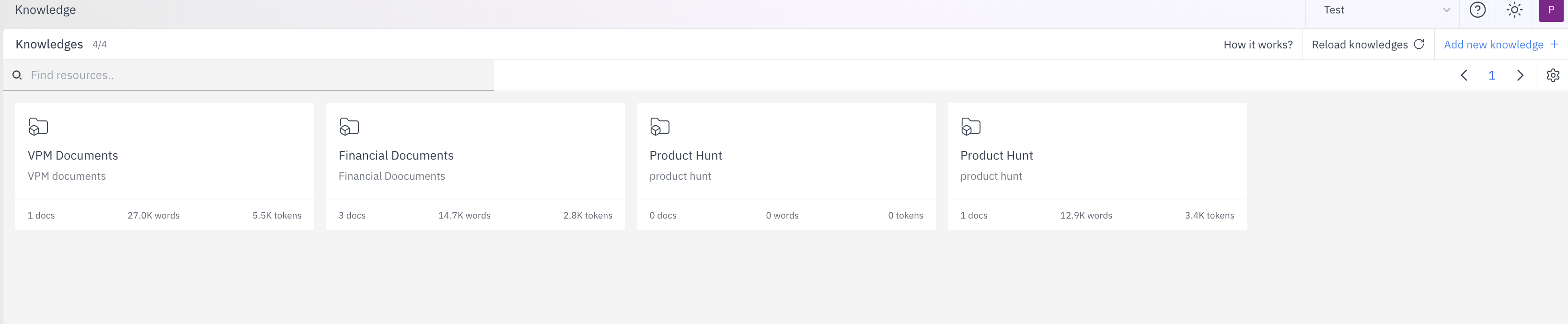
In the context of AI applications, knowledge refers to a collection of documents, data, or information that can be used to augment the capabilities of language models. It acts as a specialized database that the AI can reference to provide more accurate and contextually relevant responses.
## Key Use Cases
Knowledge integration can be utilized in various ways to enhance your AI application's capabilities:
Provide more accurate and relevant responses by referencing specific domain knowledge.
Quickly access and retrieve specific information from a large corpus of documents.
## Benefits and Capabilities
Utilizing knowledge integration offers several advantages:
Organize and categorize information for easy retrieval and association with
AI assistants.
Enable AI to make specific calls to knowledge bases for targeted information
retrieval.
Create and maintain specialized knowledge bases tailored to your
application's needs.
Easily update and expand your knowledge base without retraining the entire
model.
Incorporate various document formats including text, PDFs, and structured
data.
Implement advanced search capabilities to find relevant information beyond
keyword matching, understanding context and meaning.
Combine semantic and keyword-based approaches for more accurate and
comprehensive search results.
Enable comprehensive content analysis and retrieval, allowing users to
search through entire documents efficiently.
## Conclusion
Knowledge integration is a powerful tool that allows you to enhance the capabilities of your AI applications. By leveraging these key use cases and benefits, you can create more sophisticated, accurate, and context-aware AI features. Properly implemented knowledge bases open up a world of possibilities for improving your application's intelligence and user experience.
## What is Knowledge in AI Context?
In the context of AI applications, knowledge refers to a collection of documents, data, or information that can be used to augment the capabilities of language models. It acts as a specialized database that the AI can reference to provide more accurate and contextually relevant responses.
## Key Use Cases
Knowledge integration can be utilized in various ways to enhance your AI application's capabilities:
Provide more accurate and relevant responses by referencing specific domain knowledge.
Quickly access and retrieve specific information from a large corpus of documents.
## Benefits and Capabilities
Utilizing knowledge integration offers several advantages:
Organize and categorize information for easy retrieval and association with
AI assistants.
Enable AI to make specific calls to knowledge bases for targeted information
retrieval.
Create and maintain specialized knowledge bases tailored to your
application's needs.
Easily update and expand your knowledge base without retraining the entire
model.
Incorporate various document formats including text, PDFs, and structured
data.
Implement advanced search capabilities to find relevant information beyond
keyword matching, understanding context and meaning.
Combine semantic and keyword-based approaches for more accurate and
comprehensive search results.
Enable comprehensive content analysis and retrieval, allowing users to
search through entire documents efficiently.
## Conclusion
Knowledge integration is a powerful tool that allows you to enhance the capabilities of your AI applications. By leveraging these key use cases and benefits, you can create more sophisticated, accurate, and context-aware AI features. Properly implemented knowledge bases open up a world of possibilities for improving your application's intelligence and user experience.